
⭐️⭐️⭐️⭐️⭐️
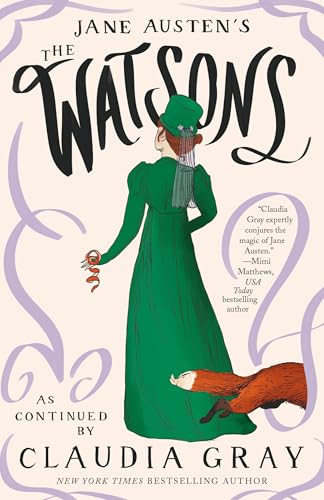
I am a huge Jane Austen fan, which meant I went into Jane Austen’s The Watsons with very mixed feelings. Of course I wanted to read a completed version of one of her unfinished novels. I also knew that attempting to finish Jane Austen’s work requires a level of confidence normally reserved for people who climb mountains without oxygen or reply-all to company emails.
There was simply so much that could have gone wrong. Austen’s voice is incredibly specific, and capturing it involves much more than putting characters in gowns, sending them to a ball and giving everyone formal dialogue. The humor has to be sharp without announcing itself. The romance has to exist alongside money, family obligation and social position. Even the most ridiculous characters need to remain believable enough that you know you have met some version of them in real life.
Somehow, Claudia Gray pulled it off.
Austen’s original story follows Ada Watson, who has spent years living comfortably with a wealthy aunt and uncle, separated from the rest of her family. When her uncle dies and her aunt makes an unfortunate new marriage, Ada is sent back to her struggling family in Wiltshire. She returns as almost a stranger to her own siblings and quickly attracts the interest of Lord Osborne, the most eligible man in the area, while finding herself much more interested in the local clergyman, Mr. Howard. Austen abandoned the manuscript before resolving whether Ada could choose love when her family desperately needed the security of a wealthy match.
That unfinished question gives Gray a very Austen-like problem to solve. Ada’s romantic future matters, but it cannot be separated from the financial reality facing the Watson women. Marriage is not simply about finding someone charming. It may determine whether Ada and her sisters have a home, social standing or any real control over the rest of their lives. Gray understood that the best Austen stories are romantic, but they are never only romances.
What impressed me most was how completely the continuation disappeared into the original. I expected to notice the handoff. I thought there would be a moment when Austen’s language stopped and the newer version began to feel slightly cleaner, faster or more modern. Instead, the transition was so seamless that I eventually stopped looking for it.
At times, it genuinely felt like Austen’s ghost was writing through Claudia Gray.
The wit was there, but Gray did not try too hard to prove she could write something witty on every page. The social observations felt natural. The characters revealed themselves through conversations, small embarrassments and terrible decisions rather than through long explanations of who they were. Even the romance had the quieter, more restrained feeling of Austen’s work, where one meaningful interaction can carry more weight than an entire chapter of dramatic declarations.
I also loved that Gray expanded the story beyond Ada’s choice between two men. The Watson family became an ensemble of people with their own disappointments, flaws and limited options. Ada’s return forces her to learn who her siblings have become without her, while they must adjust to a sister who was raised with privileges they never had. That tension gives the family relationships real emotional weight. They can love one another, resent one another and worry about what each person’s choices will mean for everyone else—all at the same time.
The supporting characters were just as carefully handled. Some were ridiculous in the exact way Austen characters are ridiculous: entirely convinced of their own good sense while behaving with none whatsoever. Others surprised me by becoming more sympathetic as their circumstances came into focus. Gray allowed people to be selfish without making them monsters and kind without making them perfect, which is one of the qualities that makes Austen’s original characters feel so enduring.
Most importantly, the conclusion felt satisfying without feeling too neat. Gray had to provide the answers Austen never wrote while respecting the realities already established in the fragment. She could not simply hand everyone money, husbands and matching cottages and call it a day. The ending needed to feel hopeful while acknowledging how little freedom these women actually possessed, and I thought she found exactly the right balance.
I gave Jane Austen’s The Watsons five stars. I expected to enjoy the chance to revisit Austen’s world, but I did not expect to become so completely absorbed that I forgot I was reading a continuation written more than two centuries later. Claudia Gray did not try to modernize Austen, compete with her or turn the fragment into a generic Regency romance. She listened carefully to the story Austen had already begun and followed it to an ending that felt as though it had been waiting there all along.
I started this book prepared to defend Jane Austen’s honor. I finished it thinking her ghost may have briefly borrowed Claudia Gray’s laptop.